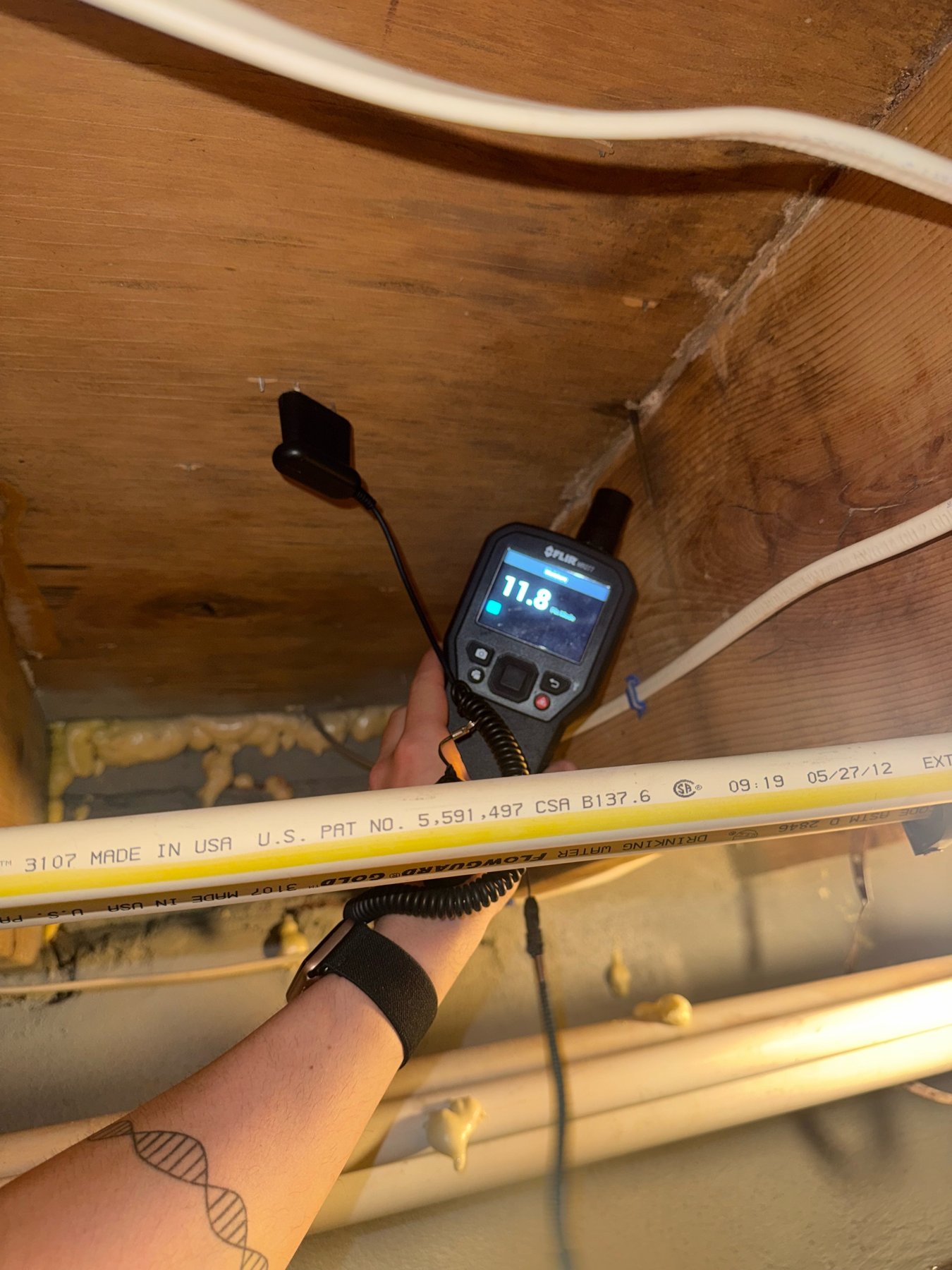
How Dry Should Wood Framing Be Before Drywall?
At or below 19% moisture content, read with a pin meter. Here is where to take the readings, how to tell growth from lumber-yard staining, and what to do when a stud reads wet.
The short answer
Framing at or below 19% moisture content (MC) passes. Above 19%, the member gets dried and read again before anyone covers it. That is the line we hold on every wood-frame project we inspect, and it is the number your crews should carry in their heads.
Read wood in MC, with a pin meter. Drywall is read on a different scale, wood moisture equivalent (WME). The two scales do not mean the same thing, so a reading is only useful when you know which one you are looking at. A foreman who says a stud reads "15" should be able to tell you which scale and which meter.
Why the reading before drywall matters
Once board goes up, nobody looks at that framing again until something goes wrong. Wet lumber behind a closed wall dries slowly, and mold needs only moisture, something to feed on, and time. EPA guidance is to dry wet materials within 24 to 48 hours to prevent mold growth. Framing that took rain for weeks before dry-in is well past that window. That is why the reading on the day before drywall counts for more than how the lumber looked on delivery day.
Water is also where the money goes. ISO data put water damage at nearly 28% of construction claims in 2017, the most common cause of builder's risk losses (source). At the far end, a 180-unit apartment complex in Corte Madera was torn apart and rebuilt for leaks and wood rot, about a year and a half late.
Where to take readings
- Bottom plates. Water runs down and sits on the slab or subfloor, right against the plates.
- Top of the building. Trusses and top plates on the top floor take every storm until the roof is on.
- Openings. Window and door rough openings, and anywhere the sheathing was open to weather.
- Where water stood. After a storm, read the framing around any spot where water sat on the floor.
- Anything darker than the wood around it. Read it first, then look closer.
What we do at a framing inspection
Framing inspections typically start once the roof is on and the framing is up. We walk each unit, read the framing with a pin meter, and look at the exposed members for growth.
When we find growth, we identify the individual area, so the remediation contractor can spot treat instead of blanket treating a whole floor. Each spot is photographed, circled in our field software, and described by room and wall letter, for example "growth on upper truss, bathroom wall D." Wall A is the wall you walk in through, B is to the left, C is the back wall, and D is to the right. Anyone on your team can stand in the doorway and walk straight to it.
After any treatment, we come back and verify the work before the walls are closed. You can see how a finding reads on paper in our sample report.
Active growth or lumber-yard staining?
A lot of lumber shows up stained. Sapwood and kiln staining is flat and old. It sits in the grain and does not change from week to week. Active growth is fuzzy, raised and spreading. It can be green, yellow, orange, black or teal, and it forms a visible three-dimensional matrix on the surface of the wood.
We judge it by touch as well as sight. Staining feels like the rest of the board. Growth has texture. If the wood itself is soft, crumbly or stringy, that is rot, and it is a different conversation from staining or surface growth.
Getting this call right saves your schedule. Treating stained lumber that was never growing costs time and money. Missing active growth on a truss means it gets closed in.
When a reading is high
A reading above 19% MC is a reason to wait, not a verdict on the building. Find the source, dry the area with air movers and dehumidifiers, and read it again before anyone hangs board. Write it down with the unit, room, wall and reading, so the second reading actually happens. A water event log does that job, and our Moisture Management Program is built around one.
The same thinking carries into the next phases. Once board is up, drywall readings take over. When the floor underlayment goes down, it puts a lot of water into the building at once, which we cover in Gypcrete, Drying Time and Mold. For how all of this fits into one written plan, see What a Construction Moisture Management Plan Should Include.
Four numbers to post in the trailer.
19% MC
Wood framing, read with a pin meter. At or below passes. Above gets dried and read again before it is covered.
16% WME
Drywall above this is elevated and conducive to mold. A board that stays above it for more than 72 hours is marked for removal instead of being closed in.
24 to 48 hours
EPA guidance for drying wet materials to prevent mold growth. Start the clock when the water shows up.
10 square feet
Visible mold of 10 square feet or more: call the hygienist that day.
Common questions.
Does stained lumber have to come out?
Not because of the stain. Sapwood and kiln staining is flat and old. We mark the spots that are active growth, and only those go to the remediation contractor.
Can my crew take the readings?
Yes, and they should. A superintendent with a pin meter catches wet framing early. Our inspection adds an independent set of readings, a photo of each finding, and a written report for the file.
When should the first inspection happen?
Once the roof is on and the framing is up. Before that, the building is still taking weather and the readings will change.
What if we find growth after the board is hung?
Write it in the log with the room, wall and size. If it is 10 square feet or more, call the hygienist that day.
Check the framing before it disappears.
The Three Phase Program inspects framing, drywall and gypcrete, with a written report and photos at each phase. Or start with a free session for your crew. Questions? Call 410-897-2629.